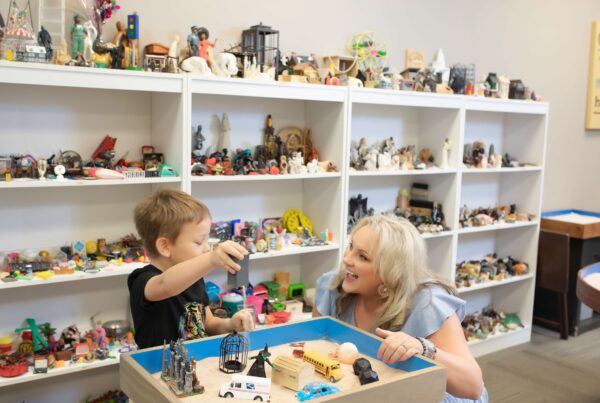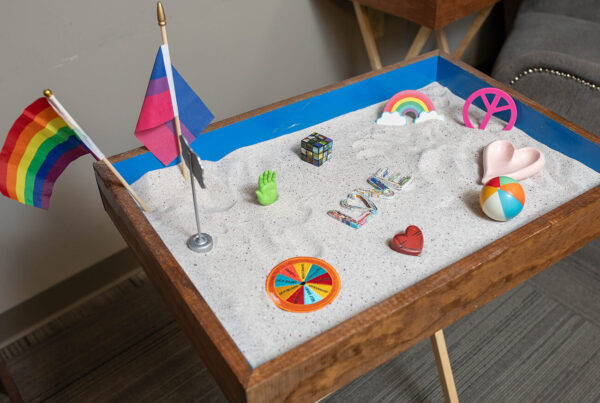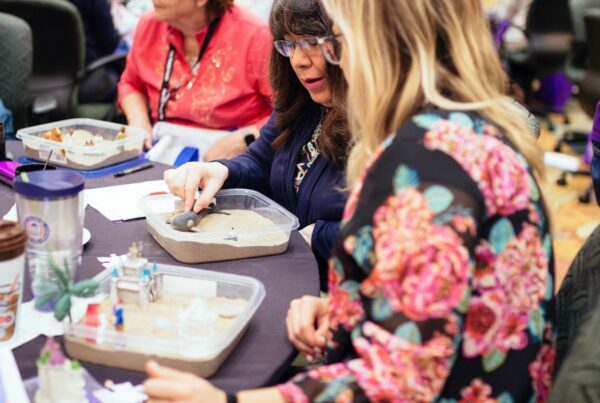
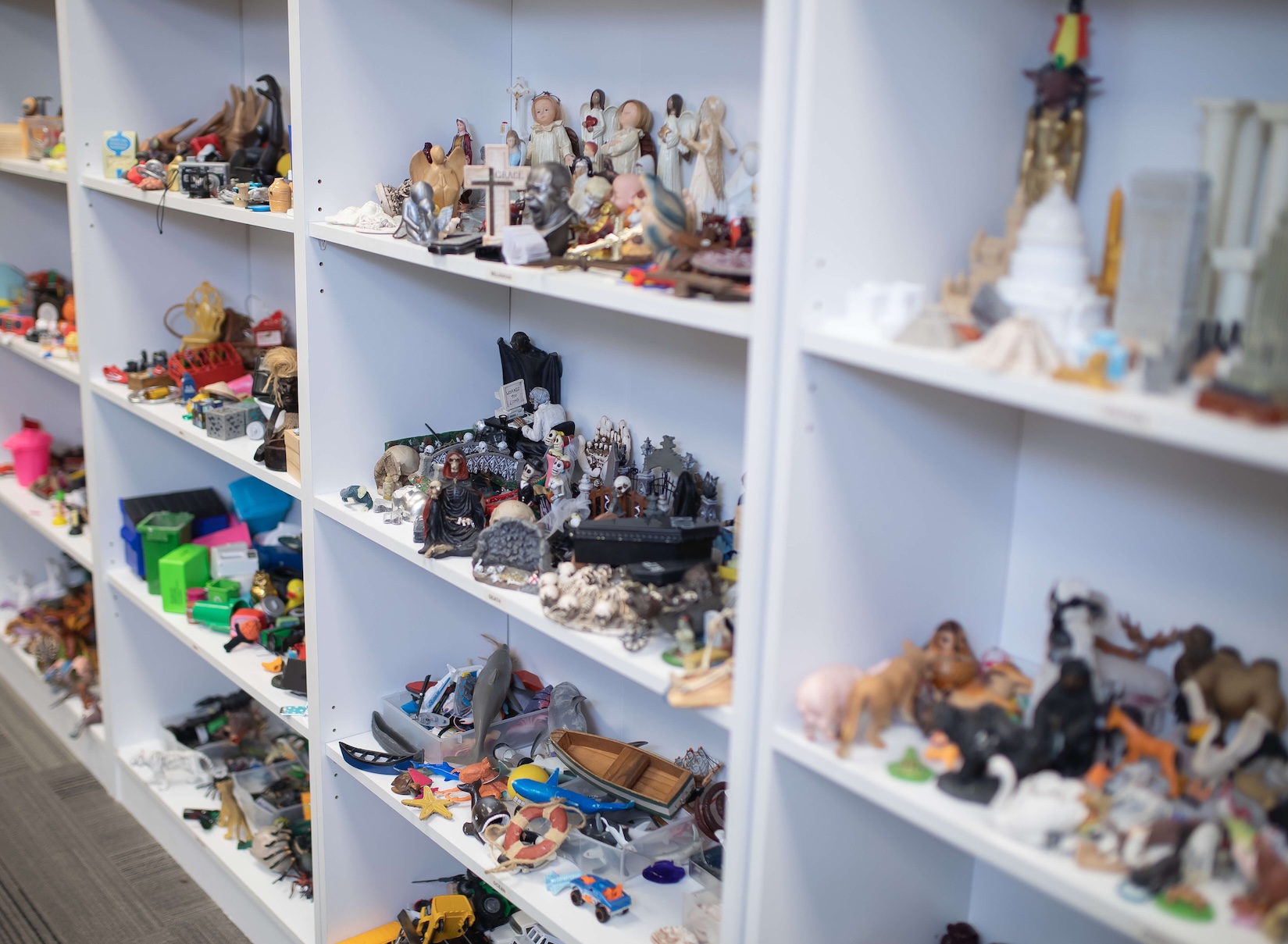
Sandtray therapy is powerful.
It allows people to make connections and gain insights they may have struggled with for years. Its strength lies in its ability to access what words often cannot—the nonverbal, right side of the brain. Sandtray brings the right hemisphere into communication with the left, the part of the brain responsible for logic, language, and reasoning. When these two systems begin to speak to one another, deep and lasting insight becomes possible.
Once someone experiences the power of sandtray therapy, it’s not something that can simply be undone.
So why is sandtray therapy so effective?
The answer lies in its access to the subconscious.
A landmark study in the mid–20th century offers a powerful illustration of this process. Neuroscientist Richard Sperry studied individuals who had undergone a corpus callosotomy—the surgical severing of the corpus callosum, the structure that connects the right and left hemispheres of the brain. This procedure was sometimes used as a treatment for severe epilepsy.
Sperry wanted to understand how separating the hemispheres affected behavior and meaning-making. In one experiment, he presented a command—“walk across the room”—in a way that could only be processed by the right hemisphere. The participant immediately stood up and walked across the room.
What happened next is where the study becomes especially revealing.
When Sperry asked the participant why they walked across the room, the left hemisphere—responsible for language and explanation—had no access to the original instruction. The participant still offered an explanation, but it was incorrect. Each subject created a reasonable, believable story to justify their behavior, even though it had nothing to do with the actual command.
This phenomenon mirrors what we often see in therapy.
Trauma, implicit memory, and emotional experiences are frequently stored in the right hemisphere of the brain. Without the right prompt, the left brain may never gain access to this information. Clients may engage in behaviors they don’t fully understand, offering explanations that feel logical but don’t quite fit. They know they do something—but not why.
It’s a fallacy to believe we have complete conscious control over our thoughts, behaviors, and motivations. Much of our behavior is shaped by older, deeper parts of the brain—areas that are not easily reached through logic or language alone.
This is where sandtray therapy becomes so powerful.
Sandtray provides a pathway to the right hemisphere through images, symbols, and sensory experience. At the same time, it invites the left hemisphere into the process through reflection, storytelling, and gentle processing. Because the corpus callosum is intact in most clients, the brain is capable of integrating these experiences when given the right conditions.
The scenes created in the sand give the right brain the raw material it needs to access memory and emotion. The processing that follows allows the left brain to witness those experiences in a tangible, three-dimensional way. What was once felt but unspoken can now be seen, understood, and integrated.
The result is a truly whole-brained therapeutic experience.
Sandtray therapy reaches aspects of the self that talk therapy alone often cannot access. It uncovers layers of meaning, emotion, and experience that have long lived outside of conscious awareness—all while holding the client in a safe, non-judgmental, and protected space.
When therapy engages the whole brain, meaningful change doesn’t have to be forced.
It unfolds naturally.With sandtray therapy, how could powerful breakthrough moments not occur?